
If you’ve been relying on brief summer rain showers to keep your solar panels clean, your monitoring app might be trying to tell you something.
Earlier this year we talked about some of the hazards and safety considerations you should bear in mind if you’re cleaning your solar panels yourself. Today, we’ll be focusing specifically on one of the harder upkeep items in a home PV system: soiling from dust, pollen, and the general weather.
There is a widespread belief among home and business owners that rainwater acts as a self-cleaning mechanism for solar arrays. While a heavy downpour can wash away loose surface dirt, summer precipitation often makes the problem worse.
By mid-to-late summer, the accumulation of fine dust, sticky spring pollen, and bird droppings transforms from a light powder into a stubborn, light-blocking crust—a phenomenon known in the industry as soiling.
Here is the hard data on how soiling impacts your production, why summer rain actually compounds the issue, and how to spot it before it drains your seasonal energy yield.
🔬 The Chemical Recipe: Why Rain Creates “Solar Cement”
In dry or high-dust regions, panels accumulate a daily coating of fine particulates. In spring and early summer, trees and flowering plants add a layer of sticky pine or flora pollen.
When light humidity, heavy morning dew, or a brief summer drizzle hits that mixture, something frustrating happens: instead of rinsing the array clean, the moisture dissolves the water-soluble sugars in the pollen and mixes with ambient alkaline dust.
As the midday sun quickly bakes the moisture away, it sets into a thin, cement-like film!
Subsequent light rains don’t carry enough volume or pressure to strip this layer off. Instead, raindrops collect more airborne dirt as they fall, pooling at the bottom edge of your panels and drying into dense, dark muddy ridges along the frame.
📉 Hard Data: How Much Energy Are You Losing?
Soiling isn’t just an aesthetic issue—it physically blocks photons from reaching the silicon wafer underneath the tempered glass.
According to studies by the National Renewable Energy Laboratory (NREL) and international photovoltaic research bodies, soiling losses vary widely based on climate, but the numbers during dry, high-dust seasons are striking:
- Moderate Soiling: In areas with light dust and occasional rain, uncleaned panels typically experience a 5% to 15% drop in efficiency over the course of a dry season.
- Severe Soiling (High Pollen/Desert Regions): In arid regions or areas downwind of agriculture and pine forests, uncleaned arrays can suffer a 20% to 30%+ drop in daily power generation.
💡 The Financial Calculation: If a 10 kW system loses 20% of its generation due to a severe pollen-and-dust film during the 90 days of peak summer sunlight, you are effectively throwing away hundreds of kilowatt-hours of clean power—often forcing your home to draw expensive grid power during peak summer rates.
📱 How to Spot Soiling in Your Monitoring App
You don’t need to climb onto your roof with a magnifying glass to figure out if your panels are dirty. You can spot soiling directly inside software apps like Enphase Illuminate, SolarEdge Monitoring, or Tesla.
Look for these two specific indicators:
1. The “Midday Ceiling” (Flatlining Peak Yield)
On a cloudless summer day, your daily production graph should look like a smooth, symmetrical bell curve. If your curve looks normal in shape but the peak height is consistently lower than it was on similar clear days two months ago, soiling is often the primary culprit (after accounting for high-heat thermal losses).
2. Micro-Inverter / Panel Variance
If you have microinverters or DC optimizers, look at the panel-level view:
- Bottom-Edge Loss: If the bottom row of panels shows lower production than the top row, mud and pollen have pooled along the lower frames, shading the bottom cells.
- Spot Shading: A single panel showing a sudden 15% to 25% drop relative to its immediate neighbors usually indicates localized bird droppings blocking a specific cell string.
🛠️ The Gold Standard: How to Safely Remove Soiling
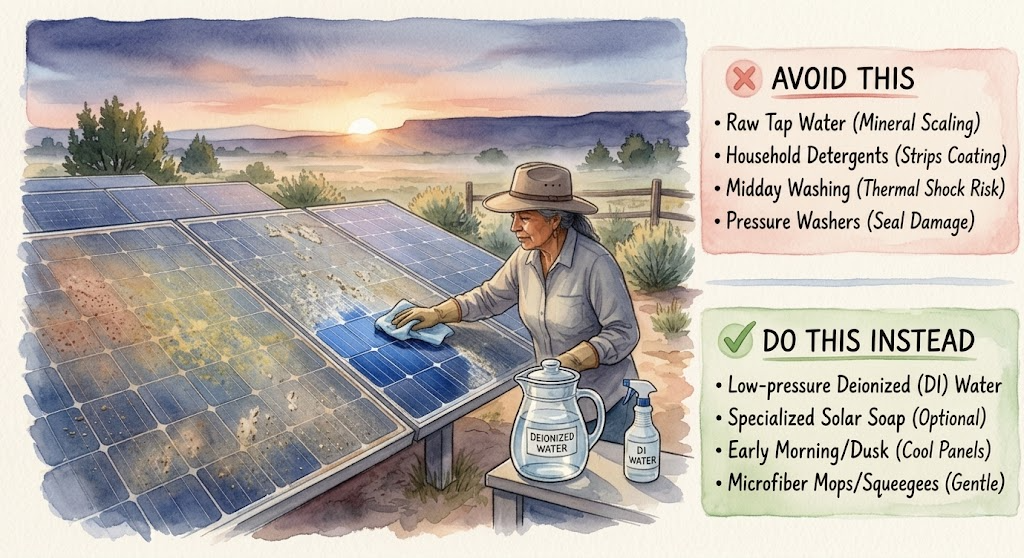
If your monitoring data confirms a drop in production, resist the urge to grab a garden hose and a bottle of dish soap.
- Use Deionized (DI) Water: Standard tap or well water contains dissolved minerals like calcium and magnesium. If you spray raw hose water onto a hot panel, it dries into a white, chalky mineral scale that is worse than the dirt you tried to remove. DI water acts like a magnet for contaminants and dries spot-free.
- Never Pressure Wash: High-pressure sprayers can force water past the rubber seals on junction boxes, damage MC4 wiring connectors, or micro-fracture the glass.
- Stick to Soft Materials: Use high-reach telescoping poles fitted with soft microfiber solar brushes or squeegees. Never use abrasive scrubbing pads or harsh household cleaners (like Windex or bleach), which strip the glass’s anti-reflective coating.