
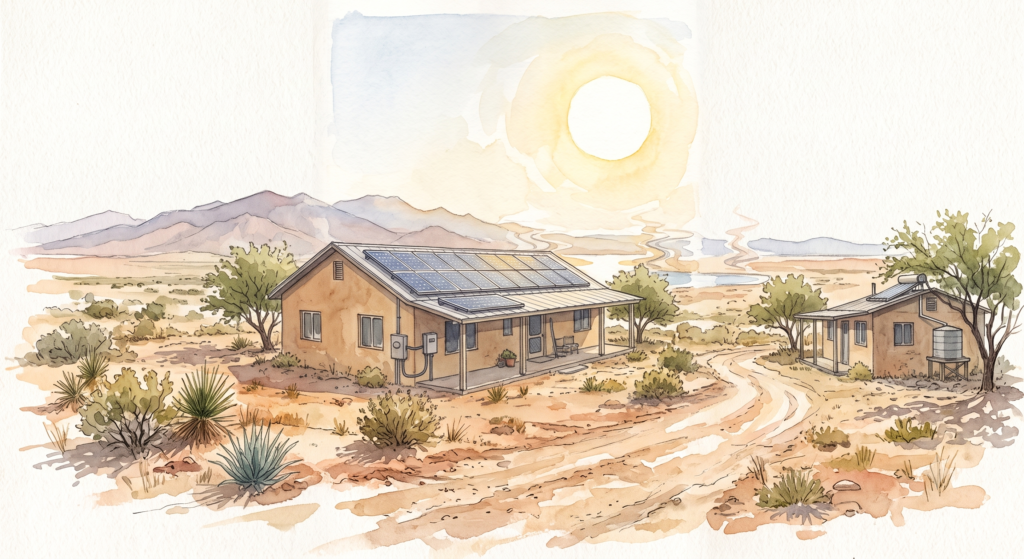
Finding the right balance for your solar system is key: your panels need lots of bright sunshine to generate power, but extreme heat can actually make them less efficient.
At ECC Solar, we know this is a concern, but living in Northern New Mexico has a special advantage: we don’t see extreme heat nearly as often as other places in the American Southwest, and with nearly 300 sunny days a year, our state is one of the best places in the world for solar energy. Understanding how your system handles heat can simply help you keep it running smoothly for years to come.
Why Heat Affects Efficiency
It’s a common myth that solar panels perform better when it’s hotter. In reality, panels convert light—not heat—into electricity. When panels get too hot, the internal electronics encounter more resistance, which slows down energy production. This sensitivity is known as your panel’s “temperature coefficient.” Basically, for every degree above 77°F, your panel’s efficiency drops slightly. On a 100°F day, a panel can hit 160°F, which can noticeably reduce its output – as much as 20%!
The High-Altitude Advantage
Luckily, New Mexico has a secret weapon: our high altitude. Because much of our state sits above 4,000 feet, the atmosphere is thinner and less dense. This means sunlight travels to the ground with less interference from air molecules and pollution. This results in incredibly intense, clear sunlight—often called “solar irradiance”—which helps offset the efficiency lost to heat. It’s why our solar systems are often more productive than those in lower-elevation deserts.
Keeping Your System Cool
To get the most out of your solar panels even when it’s hot, we use a few smart strategies:
- Load Shifting: Try running your big energy users—like dishwashers, pool pumps, or laundry—in the late morning (10:00 AM to 12:00 PM). The sun is strong then, but the panels haven’t reached their peak afternoon heat yet.
- Protect Your Inverter: Sometimes the issue isn’t the panels, but the inverter (the box that converts the energy). If your inverter is on a sunny, south-facing wall, it might overheat. Installing a simple awning or shade can prevent afternoon power dips.
- Smart Mounting: Whether on a roof or the ground, panels need a gap between them and the surface. This allows desert winds to blow underneath, acting like a natural cooling system for the panels.
- Better Technology: Newer panel types, like N-type or HJT, are designed to handle heat much better than older models, losing very little power even on the hottest days.
- Ground Cooling: For ground-mounted systems, using light-colored gravel instead of dark soil keeps the ground cooler. It reflects light back onto the panels (especially if they are bifacial, meaning they absorb light on both sides) while preventing the ground from absorbing too much heat.
Even with the desert heat, New Mexico’s combination of high-altitude sunlight and smart engineering makes our solar systems some of the most reliable in North America.
It’s not just your solar panels that might be feeling the heat if you notice an afternoon drop in your system’s energy production. In our next article, we’ll dive into what’s usually the true silent sapper of summer solar: Inverter Thermal Derating.