
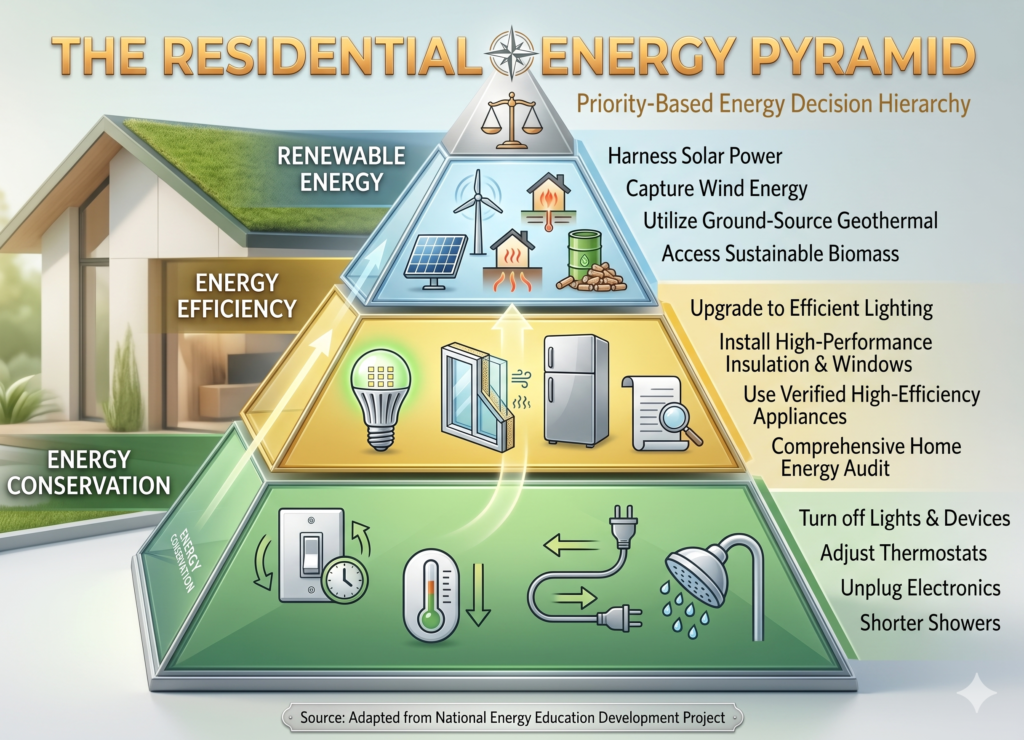
For homeowners working with ECC Solar, the “Energy Pyramid” isn’t just a diagram; it is a strategic framework designed to prevent the most common mistake in renewable energy: overbuilding.
This tool serves as a hierarchy of priorities, guiding you to address low-cost efficiency before investing in high-cost hardware. By following the layers of the pyramid, rural and residential customers in New Mexico can reduce the overall size—and price tag—of their solar array.
The Foundations: Energy Conservation and Demand Management
The wide base of the pyramid represents the most cost-effective actions you can take. Before a single panel is set in place, ECC Solar encourages “demand-side management.”
- Energy Conservation: Changes in habits are some of the most effective and immediate ways to reduce your energy usage, such as turning off unused lights or adjusting thermostat settings. It costs $0 but immediately lowers your daily kilowatt-hour (kWh) consumption.
- Demand Management: When and how you use power can prevent simultaneous high-draw cycles that can put massive strains on your system. Key tactics involve Load Shifting, which means scheduling high-consumption devices (such as dishwashers or well pumps) for peak daylight hours to capitalize on direct solar production. Automated Controls can also help ensure that multiple high-amperage appliances do not run concurrently, maintaining a balanced system demand.
- The Pro Tip: Actively managing your demand reduces peak load spikes, which is critical for off-grid systems to prevent inverter overloads and for all systems to ensure they are “right-sized.” This optimization can reduce the overall cost of your solar array and battery storage.
The Middle: Energy Efficiency
The middle of the pyramid focuses on energy efficiency, which involves making structural and appliance upgrades to the home. Unlike conservation, which is about habit, efficiency is about the technology and envelope of the building itself.
- Sealing and Insulation: Properly insulating attics and sealing air leaks around windows and doors prevents conditioned air from escaping, significantly reducing the load on heating and cooling systems.
- Appliance Upgrades: Replacing old, inefficient appliances with Energy Star-rated models ensures that your home performs the same tasks while consuming far less electricity.
- Monitoring: ECC Solar’s documentation emphasizes using real-time monitoring tools to identify “vampire loads”—devices that suck power even when turned off.
The Apex: Renewable Generation & Storage
Only once the home is “lean” does the pyramid reach its peak: renewable energy sources and storage, of which ECC Solar specializes in Solar Photovoltaics (PV) and Battery Storage.
- Right-Sizing: Because you’ve addressed the lower levels of the pyramid, your system is now “right-sized.” You aren’t paying to power an inefficient refrigerator or a drafty attic.
- Storage: In rural New Mexico, the battery is the crowning piece of the pyramid, providing mission assurance during grid outages.
How to Use the Tool
A homeowner should use the Energy Pyramid as a checklist during the consultation phase with us at ECC Solar. Instead of asking, “How big of a system can I get?” the better question is, “How low can I get my base load before we even design the system?”
By following this “bottom-up” approach, you ensure your investment with ECC Solar is optimized for longevity and ROI, turning your property into a model of high-desert efficiency rather than just a large-scale power plant.